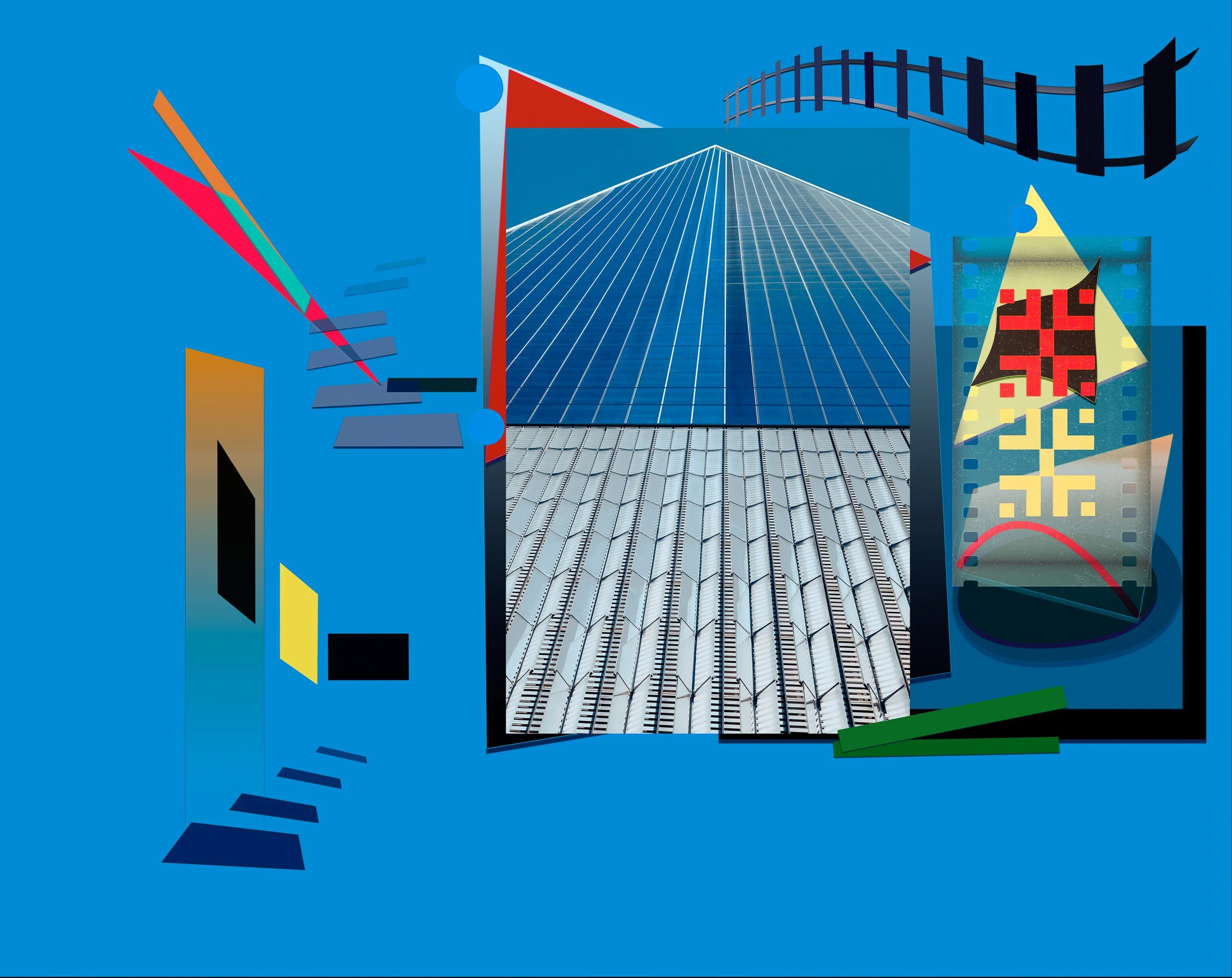
The Story Behind Downtown Story
Downtown Story began with a simple realization: I missed downtown Manhattan. There is something about downtown that has always drawn me in. Its streets carry layers of history, while the skyline continues to reinvent itself. Glass towers rise above cobblestones. New buildings stand beside traces of New York’s past.
Downtown Story began with a simple realization:
I missed downtown Manhattan.
After returning from an artist residency in 2025, I hadn't been downtown in more than a month. When I finally stepped off the ferry and walked those streets again, I felt an unexpected excitement. It felt like returning to a place I knew intimately. Something about downtown has always drawn me in. Its streets carry layers of history, while the skyline keeps reinventing itself. Glass towers rise above cobblestones; new buildings stand beside traces of New York's past.
Although Downtown Story began with the Broken Series, my connection to architecture started much earlier. As a child in Bucharest, my father introduced me to drawing through architecture. He had always dreamed of becoming an architect, and he taught me about proportion, perspective, and the geometry of buildings. Together, we looked at the city's facades and streets, and what began as drawing lessons gradually became lessons in observation. I learned that buildings are more than structures; they hold personal memories, collective histories, and the stories of the people who move through them.
Years later, after moving to New York, I turned to photography to explore the city. At first, I was drawn to architecture for its forms, rhythms, and geometry. Over time, my interest expanded beyond structure alone. I became interested in how places shape our sense of identity and belonging, especially in a constantly changing city. These early photographs and studies eventually led to the Broken series and, within it, Downtown Story.
In this work, the city I photographed becomes inseparable from the city I remembered—a place continually rebuilt and continually rediscovered. What began as an exploration of architecture and geometry evolved into a broader reflection on memory, migration, change, and the experience of finding one's place within an ever-evolving city.
Studio Note #3 by Roxana Gheorghe

Fragments, Reconstruction, and Space
Fragments entered my work long before I began making art. From engineering and mechanical design to photography and digital intervention, fragmentation became a way of understanding space—and eventually memory, migration, and reconstruction.
Fragments entered my work long before I began making art.
During my engineering studies and later while working as a mechanical designer, I learned to understand complex forms by breaking them apart. To draw the developed surface of an object—whether a machine component, a curved structure, or a building element—I had to imagine its surfaces unfolded and laid flat. I measured forms, separated them into planes, and then reconstructed them. A shape became understandable through fragmentation.
What fascinated me was not only the object itself, but the transformation. A flat surface could be bent, twisted, folded, or assembled into something entirely different. Space was no longer fixed. It could be interpreted from multiple viewpoints and reorganized into new relationships.
Years later, I recognized that the same way of seeing had entered my artwork.
In New York City New Bauhaus, architectural photographs become raw material for reconstruction. Buildings dissolve into geometric planes, shifting perspectives, and intersecting structures. The work explores how we perceive, remember, and reimagine space.
Reconstruction also carries personal meaning.
After leaving Romania and building a life in the United States, I experienced my own process of fragmentation and reassembly. Familiar structures—cultural, personal, and professional—were broken apart and reorganized into something new.
The fragments in my work are therefore both spatial and emotional. They reflect a way of understanding architecture, memory, and identity as forms that are constantly being reconstructed.
Studio Note #2 by Roxana Gheorghe